Thursday, September 20, 2012

Women's Studies visit, September 2012


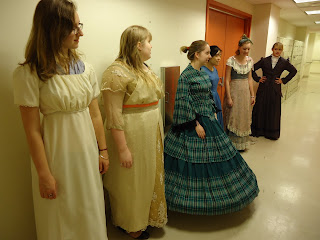
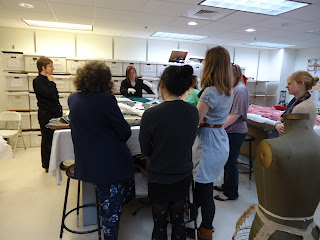
On September 20th, we had the pleasure of a visit from Susan Hiner's class: Women's Studies 241, "Fashion and the Feminine." After a few minutes looking at the authentic objects we had on display, the students formed groups of 2-3 to try on reproductions, with one person trying on, one person as a dresser, and one person taking notes about the experience. Then we looked at some of the authentic objects in greater detail, making comparisons to what they were wearing. Finally, after they undressed (and could come in closer without the burden of farthingales, hoops, bustles, and trains), we spent our final moments continuing to discuss the finer details of some of the objects from the collection.


If you're having trouble viewing this slideshow, you can view it directly in Picasa; from there you can see a full screen view, or download your own copy of an image.

This visit also provided us an opportunity to display a dress that we have never displayed before, a gown from the 1910's (just about a century old!). It was exciting to see this gown on a mannequin for the first time, and to see just how much of a hobble skirt it really has. Unfortunately we weren't able to steam it, but it's still great to see on a mannequin.


It also was lovely to see this dress juxtaposed with the pink 2 piece dress (right hand side) from only a few years previous, from the early 1900's. What a change in silhouette in  just around a decade! Yet another juxtaposition was the 1950's gown on the left, providing us an opportunity to discuss how fashion often moves in cycles, with skirts moving from wide to narrow, then widening again.
From Visit from Women's Studies 241
Creative Commons License
All the images shown in this post are from the Vassar College Drama Department Research Collection of Historic Clothing and are licensed under a Creative Commons Attribution-NonCommercial-ShareAlike 3.0 Unported License.

Tuesday, May 8, 2012

Visit from Project Aware, May 2012

The young women from the Mill Street Loft's Project AWARE (in Beacon) came to visit us on May 8, 2012. They had a lot of fun trying on reproduction costumes, and then had some great questions and ideas when we looked at actual historic clothing from the collection.

Here's a slideshow with some images from their visit.


If you're having trouble viewing this slideshow, you can view it directly in Picasa; from there you can see a full screen view, or download your own copy of an image.

Friday, November 18, 2011

History and Drama class visits


The fall of 2011 was a busy time for Vassar's collection of historic clothing. After the September visit from Susan Hiner's class, we had a day in November that we did double-duty: two classes visiting in one day! While that made for a busy day, it's wonderful for us to fit more than one visit into one day. A lot of time goes into setting up and taking down the materials for each visit, so if we can get more students in to see the objects while they're out, that's great! Here's a slideshow from the morning visit:


If you're having trouble viewing this slideshow, you can view it directly in Picasa; from there you can see a full screen view, or download your own copy of an image.

In the morning, Students from Kenisha Kelly's Drama class "History of Fashion for the Stage" came to visit. This was not our usual "Trying on History" visit - instead, we used the whole class period to allow students to do a "close reading" of one of the historic objects on display. The class was broken into four smaller groups, and each group focused on studying one object from the collection. Then the class was broken into different groups, mixing from the previous groups, so that each student could view all of the objects on display and learn from the other students who had studied each garment in greater depth. The objects were laid out on tables, rather than displayed on mannequins, so that students could examine the interior construction as well. However, we did provide a photograph of each object mounted on a mannequin, so that the students could see the correct silhouette of the garment on a body (something that can be hard to imagine).


Then, in the afternoon, Rebecca Edwards brought in students from her History/Women's Studies class, "Pathways to Vassar: The Rise of Women's Higher Education in Historical Context." They tried on reproduction garments, examined the historic objects on display on tables, and related what they saw and felt to their study of changes in women's education.


You can also view these images in our Picasa Web Album.


Thursday, September 22, 2011

"Fashion's Empires" Class Visit


In the fall of 2011, Susan Hiner brought her French class for a visit to Vassar's historic clothing collection, to view objects from the collection, try on reproductions, and explore the subject of "Fashion's Empires."

Take a look at this slideshow from their visit:


You can click on the slideshow to go to the Picasa Web Album with the images; from there you can see a full screen view, or download your own copy of an image.

If you're having trouble viewing this slideshow, you can view it directly in Picasa.

Tuesday, November 16, 2010

Drama Costume History Class Visit, Fall 2010


Editor's note: We've been busy with "Trying on History," but you wouldn't know it from this blog! To catch up, we'll be sharing several posts from visits over the last two years. Here's the first! 

Vassar's Costume Designer, Kenisha Kelly, had her Costume History class participate in our "Trying on History" activity in November of 2010. This activity has its roots in the Drama Department's Costume History class, but over the years it has grown to provide further outreach to other Vassar classes and local community groups. Still, our costume history class visitors are the best prepared for this activity!

Take a look at this slideshow from their visit:


You can click on the slideshow to go to the Picasa Web Album with the images; from there you can see a full screen view, or download your own copy of an image.

If you're having trouble viewing this slideshow, you can view it directly in Picasa.

Sunday, May 30, 2010

Visit from Project AWARE

On May 12, 2010, the VCCC hosted some of the girls from the Mill Street Loft's Project AWARE (in Beacon). We all had a great time - thanks for coming, ladies!

Here's a slideshow with some images from their visit.


You can click on the slideshow to go to the Picasa Web Album with the images; from there you can see a full screen view, or download your own copy of an image.

Friday, October 9, 2009

Class Visit - French 183

On October 8, 2009, the VCCC also hosted Susan Hiner's class "Fashion and Modernity." Here's a slideshow with some images from their visit.


You can click on the slideshow to go to the Picasa Web Album with the images; from there you can see a full screen view, or download your own copy of an image.

Class Visit - Drama 231

On October 8, 2009, the VCCC hosted two class visits, including Holly Hummel's History of Fashion for the Stage. Here's a slideshow with some images from their visit.


You can click on the slideshow to go to the Picasa Web Album with the images; from there you can see a full screen view, or download your own copy of an image.

Monday, June 1, 2009

Construction of the Reproduction

What construction techniques were used to make this dress?

We've made a lot of progress, and the reproduction is almost done. Take a look at this slideshow, showing many of the steps along the way (and many students helping out).


A great deal of credit goes out to the following students for their hard work to actually put the reproduction together:

Emily Riehl-Bedford (many parts of the bodice - and she was the one who stuck around after finals to help put it all together!)
Jessica Barksdale (skirt)
Chloe Boxer (bodice)
Elisabeth Watson (overskirt and overlays, lace skirt)
Emily Leimkuhler (lace skirt)
Danielle Morvant (pleated sash)
Margaret Dwyer (cutting out parts of the bodice)
Sharon Scoble (lace skirt)
Emily Antenucci (sleeves)

(If I'm forgetting anything or anyone, just let me know and I'll edit!)

Sunday, May 31, 2009

Costume History meets Chemistry

What are the different fabrics, trims, and hardware used in the dress?
Where were they produced, under what conditions, and at what cost?

Three weeks ago, on Friday, May 15th, Holly Hummel and I (Arden Kirkland) had a wonderful visit to Vassar's Chemistry Department. We met with Stuart Belli and Edie Stout, who were very generous with their time and introduced us to two different instruments, which in turn introduced us to a whole new world of fiber analysis.

First they introduced us to the Fourier transform infrared (FTIR) spectrometer, which measures how infrared light is absorbed by a substance. This is a non-invasive technique. We started by placing small fragments of fabric in the spectrometer (one at a time) to analyze them, but later in our session Edie was able to test the sleeve of her shirt while she was wearing it! This has great potential for analyzing fibers of textiles without needing to remove a sample. The most common method for fiber analysis in a costume shop (vs. a lab) is to do a burn test, which requires that you remove a sample from the textile and essentially destroy it. Standard microscopy is also possible, but even for that I believe you would usually want to cut a small sample to place on a slide. A non-invasive technique is greatly appreciated.

By comparing our results with those from a known sample, we were able to easily recognize patterns and determine composition. Our samples included the silks from the dress discussed in this project, and a few other samples. They had samples of silk, wool, and cotton that we could compare. We also discovered that Holly was wearing a linen shirt, so we analyzed her shirt (again, while she was wearing it) to have a linen to compare, as well.

We were pretty sure that the samples from this dress were silk, and the spectrometer easily confirmed that. Here's the result from our analysis of the skirt lining, which shows a typical pattern for silk:
From Chemical Analysis

On the simplest level, this makes it very easy to determine if something is silk or wool or cotton or linen, etc., and in a non-invasive way. On a more complex level, we see a potential to look for subtle differences in a larger sample to determine more specific variations, for example identifying regional differences in textiles, or dating textiles by identifying other compositional factors involved in the manufacturing of different time periods.

Next, we went upstairs to experiment with the XRF (X-ray fluorescence) spectrometer. We inserted the same samples. In this case, the instrument was able to analyze the presence of certain specific elements. This was particularly interesting for our silk samples, which we believed had been weighted with metallic salts, as was common in the late 19th and early 20th century. This weighting unfortunately leads to an increased rate of deterioration. We were hoping to prove that they were weighted, and to find out what they were weighted with.

Indeed, all our silks were found to be weighted at least with zinc. Our worst offender, the silk gauze (badly deteriorated) that formed the sleeves, was found to have not only zinc, but also iron, copper, potassium, and lead. Here's the analysis of that gauze:

From Chemical Analysis

We're very excited about the potential to analyze more of the textiles in our collection. There's a lot more to be figured out here, but this is a great beginning. Next comes the "So What?" Why add zinc or copper or lead to silk? How were they added? We've started by looking at similarities, but over time it may be more interesting to look at differences. We're hoping to find some students who are interested in both science and design who might want to take this on as a project. Design meets Science! Costume History meets Chemistry! This is a great example of what a liberal arts education is all about.

Thursday, May 7, 2009

Hi, Project AWARE! Thanks for a great visit!

Yesterday we had a visit from the girls in the Project AWARE program in Beacon. We had a wonderful time - the girls had very thoughtful questions about the collection, which got us all thinking about what life was like 100 or so years ago. Their challenge now is to imagine what fashion might be like 100 years from now, in 2109.

I'll try to post some images soon from our time together.

Monday, May 4, 2009

Cutting and Draping the Lace Skirt

What construction techniques were used to make this dress?

Here's a slideshow showing the steps to build the lace skirt of the reproduction.

Saturday, May 2, 2009

About this blog

This blog is about Vassar College's Trying on History project - but for now, it mostly follows one dress.

Yes, one dress. What can it tell us? What can we learn from it?

With a team of students, I have studied this dress down to the tiniest detail. We have measured it, drawn it, photographed it. We have patterned it. We are reproducing it. We are reproducing the corset that would have been worn under it. We are researching it, and its context. Who wore it? Why? Who made it? Why? How? (take a look at our full list of questions)

Yes, it's just one dress, but from it we're learning about New York City in the 1910's - and both the students who help to build the reproduction and the students who get to wear the reproduction will be able to step back in time.

To begin, you can start with some Highlights, or just browse around!

-Arden Kirkland
Vassar College Costume Collection (VCCC)
Vassar College Drama Department

Sunday, April 19, 2009

Format Question to My Readers

Here's a question for anyone following this blog - when it comes to presenting images of our process, which do you prefer - individual images in a row, or a slideshow of images? If you prefer the slideshow, which do you like better - the format from Picasa, or the format from Flickr?

Please leave a comment below to answer these questions.

Your answers will help me to decide how to format future posts.

Thank you!

Wednesday, April 15, 2009

Steaming Lace

What construction techniques were used to make this dress?

I wish I hadn't forgotten to bring back the camera today - I missed a great photo op.

Today we almost were ready to start cutting the lace skirt, but when we tried to lay it out, we realized that after the dyeing, the embroidered parts had shrunk a bit more than the overall body of the lace. So, luckily Emily Leimkuhler (VC ' 10) got to steam it all out! She pinned the whole length of yardage up along the storage boxes that line one wall of the shop, and then set to steaming. It would have been a great photo, and I'm sure she would have loved to record the moment for posterity. Because the lace is pretty sheer, at times it looked like she was just steaming the boxes!

Anyway, thanks, Emily!

Tuesday, April 14, 2009

Construction Order of the Original

What construction techniques were used to make this dress?

After carefully studying the construction details of the original dress, I think I've figured out the steps taken to put it together. Here's a slideshow with some detailed images:


For our construction steps on the reproduction, I've made a few changes to incorporate some modern conveniences, like serging raw edges.
To view a table with the details, go to:

Wednesday, February 11, 2009

Final Materials

Where can we find similar fabrics, trims, and hardware to reproduce the dress?

Now that the lace and jacquard have been dyed, we can show you swatches of all our fabric choices:

From Dyeing

Friday, February 6, 2009

Dyeing

Where can we find similar fabrics, trims, and hardware to reproduce the dress?

Two of our fabrics, the silk jacquard and the beaded lace, needed to be dyed for the color to match the original more precisely. Here are the swatches from our attempt to make the match. Students Chloe Boxer (VC '12), Emily Leimkuhler (VC '10), and Charlie Pane (VC '10) all helped to get the dyeing just right. We started dyeing on Weds., and thought we were done, but looking at it dry on Friday morning, it still wasn't quite right. We worked on it throughout the day, taking the fabric out of the vat, adding just a few more grains of dye, and putting the fabric back in to try again - it was certainly tedious, but we finally got it just right!

From Dyeing


From Dyeing

Friday, January 9, 2009

Mockup Fitting

What would the flat pattern for the dress look like?
What would the dress have looked like in 3D? In motion?

We finally had a mockup fitting to try out the pattern of the enhanced size reproduction!

Here's a slideshow from the fitting.I'm trying out the slideshow feature from Flickr - if it doesn't show up, please try a different browser. Click on the arrow (play button) for it to start playing. You can also click on the icon in the bottom right hand corner for a fullscreen view - and then, to get out of it, press the "esc" key.

The fitting went amazingly well, with only a few minor alterations. I'm patting myself on the back for my draping!

Thursday, January 8, 2009

Final Draping Step for Enhanced Size

What would the flat pattern for the dress look like?

I spent some time over the break working on the pattern and mock up at home.
Here's the last step of the draping for the enhanced size - the overskirt.

From Draping - Enhanced Size


From Draping - Enhanced Size